

Last Updated: April 14, 2026
Introduction: How Common Is Surgery in the United States?
Surgery is one of the most frequently performed medical interventions in the United States. Millions of Americans undergo surgical procedures every year — from routine outpatient operations to complex inpatient procedures that require extended hospital stays. Surgical healthcare expenditures account for more than one-quarter of all healthcare-associated costs in the country, making it one of the largest segments of the American medical system.
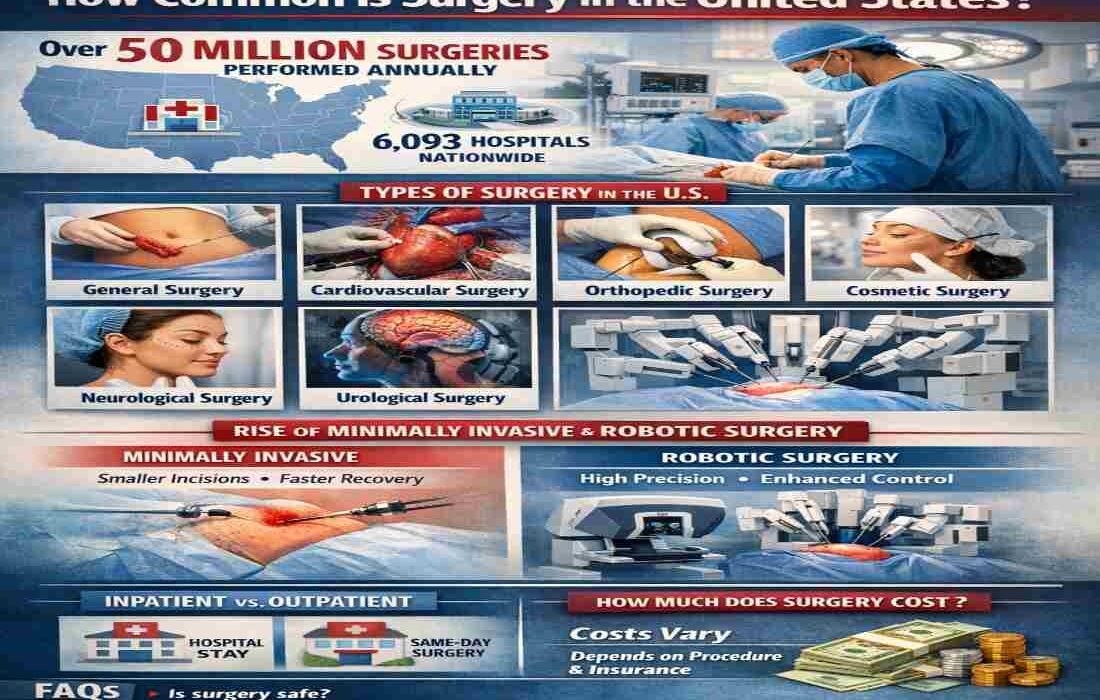
According to data from the American Hospital Association, there are currently 6,093 hospitals operating across all 50 states, the majority of which perform general and specialized surgical procedures daily. The healthcare system’s capacity to deliver surgery at scale is one of the defining features of American medicine — and understanding how that system works is essential for every patient.
Types of Surgery Performed in the United States
Surgical procedures in the US span a vast range of specialties and complexity levels. They are broadly categorized by purpose, technique, and setting.
1. General Surgery
General surgery covers procedures involving the abdomen, digestive tract, skin, and soft tissues. Common general surgical procedures include appendectomy (removal of the appendix), cholecystectomy (gallbladder removal), hernia repair, and colectomy. These are among the most frequently performed operations in American hospitals each year.
2. Cardiovascular Surgery
Heart and vascular surgery includes procedures such as coronary artery bypass grafting (CABG), heart valve repair or replacement, and aortic aneurysm repair. According to hospital data, cardiac catheter insertion procedures were among the most common inpatient surgeries performed in the United States in 2024.
3. Orthopedic Surgery
Orthopedic procedures focus on bones, joints, and musculoskeletal tissue. Knee replacement, hip replacement, spinal fusion, and ACL reconstruction are among the most commonly sought orthopedic surgeries. Demand is rising in step with an aging American population.
4. Cosmetic and Reconstructive Surgery
The United States is one of the world’s leading nations for cosmetic and reconstructive surgery. In 2024, the most prevalent cosmetic surgical procedures included breast augmentation, liposuction, rhinoplasty, eyelid surgery, and tummy tuck. The total estimated volume of cosmetic procedures in the US in 2025 is projected between 6.2 and 6.6 million, with non-surgical treatments continuing to dominate volume growth.
5. Neurological and Spinal Surgery
Neurosurgery encompasses brain and spinal cord operations, including tumor removal, deep brain stimulation, spinal decompression, and disc surgeries. Advances in imaging and navigation technology have significantly improved outcomes in this specialty.
6. Gynecological Surgery
Common gynecological procedures include hysterectomy, myomectomy (fibroid removal), and endometriosis treatment. Robotic-assisted hysterectomy has grown substantially in popularity, driven by its precision, smaller incisions, and faster recovery times.
7. Urological Surgery
Urology is one of the specialties most transformed by robotic technology. Radical prostatectomy, nephrectomy, and cystoscopy are among the most common urological procedures, with approximately 40 to 45 percent of urology surgeries in the US now performed using robotic systems.
The Rise of Minimally Invasive and Robotic Surgery
One of the most important developments in American surgery over the past two decades has been the rapid adoption of minimally invasive techniques and robotic-assisted surgery. These approaches are fundamentally changing how procedures are performed, how patients recover, and what outcomes are possible.
What Is Minimally Invasive Surgery?
Minimally invasive surgery (MIS) uses small incisions rather than large open cuts, reducing trauma to surrounding tissue. Techniques include laparoscopy, thoracoscopy, and endoscopy. Benefits for patients typically include less postoperative pain, reduced risk of infection, shorter hospital stays, and faster return to daily activities.
Robotic-Assisted Surgery in the US
Robotic surgery has emerged as one of the fastest-growing areas of American medicine. The da Vinci Surgical System, FDA-approved for general minimally invasive surgery in July 2000, remains the dominant platform and is responsible for over 1.8 million robotic-assisted procedures annually in the United States alone.
In 2025, robotic surgery appears to be overtaking traditional laparoscopic surgery in several key specialties. Research indicates robotic techniques are now surpassing laparoscopic approaches in prostatectomy, pancreatectomy, and hepatectomy. The global robotic surgical systems market was valued at $9 billion in 2024 and is projected to reach $15 billion by 2029.
Beyond da Vinci, companies including Medtronic, Johnson & Johnson, and CMR Surgical are developing next-generation robotic platforms, increasing competition and expanding patient access.
Key advantages of robotic surgery: smaller incisions, reduced blood loss, 3D visualization, enhanced surgical precision, and shorter hospital stays compared to traditional open procedures.
AI and the Future of Surgery
Artificial intelligence is beginning to play a role in surgical planning, navigation, and real-time decision support. Augmented reality (AR) systems are emerging as tools to overlay digital information onto the surgeon’s view in the operating room. The integration of AI with robotic platforms is expected to further standardize outcomes and expand access to complex procedures across diverse healthcare settings.
Inpatient vs. Outpatient Surgery: What Is the Difference?
Surgery in the United States is performed in two primary settings. Inpatient surgery involves an overnight or multi-night hospital stay, typically reserved for more complex or high-risk procedures. Outpatient surgery — also called ambulatory or same-day surgery — allows patients to return home the same day. The most common outpatient procedure in 2024 was esophagogastroduodenoscopy (EGD), a diagnostic procedure of the upper digestive tract.
Ambulatory surgery centers (ASCs) have grown significantly as alternatives to hospital-based care for elective and lower-risk procedures, offering reduced costs and more convenient scheduling for patients.
How Much Does Surgery Cost in the United States?
Surgery costs in the US vary enormously depending on procedure type, facility, geographic location, surgeon credentials, and insurance coverage. Cosmetic surgeries not covered by insurance can range from a few thousand dollars for minor procedures to $20,000 or more for complex operations. Major inpatient procedures such as cardiac bypass surgery or spinal fusion can cost well into the six figures without insurance.
Health insurance — whether private, Medicare, or Medicaid — significantly affects out-of-pocket costs. Patients are encouraged to obtain detailed cost estimates, understand their deductibles and co-pays, and seek prior authorization for elective procedures whenever possible.
For those exploring elective or cosmetic surgery, financing plans and medical credit products are widely available, though patients should review interest rates carefully before committing.
How to Prepare for Surgery: Key Steps
Preparing properly for a surgical procedure improves outcomes and helps recovery go more smoothly. Here are the essential steps every surgical patient should take:
- Consult with a board-certified surgeon and ask about their experience with your specific procedure.
- Disclose all medications, supplements, and medical history to your surgical team.
- Follow pre-operative fasting and medication instructions precisely.
- Arrange transportation and post-operative support at home before your procedure date.
- Ask your surgeon about what to expect during recovery, including activity restrictions and warning signs.
- If you smoke, quitting before surgery significantly reduces complication risk.
- Discuss anesthesia options and any concerns with your anesthesiologist in advance.
Surgery Recovery: What to Expect
Recovery timelines vary widely depending on the type and complexity of the procedure, the patient’s overall health, age, and adherence to post-operative instructions. Minimally invasive procedures generally carry shorter recovery periods than open surgery. Laparoscopic cholecystectomy, for example, often allows patients to return to normal activity within one to two weeks, while open abdominal surgeries may require six to eight weeks of recovery.
General Recovery Tips After Surgery
- Follow your surgeon’s wound care instructions carefully to prevent infection.
- Attend all follow-up appointments to monitor healing progress.
- Stay hydrated and eat a nutrient-rich diet to support tissue repair.
- Avoid strenuous activity until cleared by your medical team.
- Take prescribed pain medications as directed and taper off as healing progresses.
- Watch for signs of complications such as fever, excessive swelling, redness, or unusual discharge.
Nutrition and Holistic Recovery
Alongside medical care, nutrition plays a vital role in surgical recovery. Protein-rich foods support tissue repair, while vitamins C and D, zinc, and iron are known to aid healing. Staying mobile — within your doctor’s guidelines — helps prevent blood clots and improves circulation. Many patients also benefit from physical therapy, especially after orthopedic procedures.
Natural and integrative approaches can complement conventional post-operative care. Reducing inflammation through diet, managing stress, and prioritizing sleep are all evidence-supported strategies to improve recovery outcomes.
How to Choose the Right Surgeon in the United States
Choosing a qualified surgeon is one of the most consequential decisions a patient can make. Here are the key factors to evaluate:
- Board certification: Confirm your surgeon is certified by the relevant American Board specialty (e.g., American Board of Surgery, American Board of Plastic Surgery).
- Experience and volume: Surgeons who perform a procedure frequently tend to achieve better outcomes. Ask how many times they have performed your specific operation.
- Hospital affiliation: The quality and resources of the hospital or surgical center matter as much as the individual surgeon.
- Patient reviews and outcomes data: Many hospitals publish surgical outcome data. Ask your surgeon about their complication and readmission rates.
- Second opinions: For elective or complex procedures, seeking a second surgical opinion is common practice and generally encouraged.
Frequently Asked Questions About Surgery in the United States
Is surgery safe in the United States?
The United States has some of the most rigorous surgical safety standards in the world, including accreditation requirements for hospitals, certification standards for surgeons, and regulatory oversight by the FDA and state medical boards. While all surgery carries risk, outcomes have improved significantly over recent decades due to advances in technique, anesthesia, and perioperative care.
What is the most common surgery performed in the US?
Among inpatient procedures, cardiac surgeries such as central catheter placement rank highly. For outpatient and diagnostic procedures, endoscopic examinations of the digestive tract are among the most frequently performed. In cosmetic surgery, liposuction consistently ranks as the most common surgical procedure for both men and women.
How long does surgery recovery take?
Recovery time depends entirely on the type of surgery. Minor outpatient procedures may require only days of rest, while major open surgeries can require months of recovery. Your surgeon will provide a personalized timeline based on your specific procedure and health profile.
Does health insurance cover surgery in the US?
Most medically necessary surgeries are covered in part or in full by health insurance, subject to deductibles, co-pays, and network restrictions. Elective and cosmetic procedures are generally not covered. Always verify coverage with your insurance provider before scheduling surgery.
Conclusion
Surgery in the United States is a vast, sophisticated, and rapidly evolving field. From routine outpatient procedures to cutting-edge robotic-assisted operations, American medicine offers patients an extraordinary range of surgical options. Understanding the types of surgery available, how to prepare and recover, and how to choose the right provider empowers patients to navigate their care with confidence.
Whether you are researching a planned procedure or seeking guidance after a new diagnosis, informed patients consistently achieve better outcomes. Consult with a board-certified specialist, ask the right questions, and take an active role in your surgical journey.