

Last Updated: October 30, 2026
Something shifted in how health-conscious consumers interact with product information. Gradually at first, across most of a decade, then noticeably faster. The “trust the label” era ended quietly and without much announcement. Supplements used to succeed mostly on marketing.
A compelling brand story and confident front-label language were usually enough.
Now a meaningful portion of buyers walk past the front label entirely and go straight to the ingredient list, the sourcing documentation, and the third-party certificates. The front label is essentially marketing wallpaper for this group.
That shift has specific implications for the peptide space.
What Clean-Label Thinking Actually Means
Clean-label thinking started in food, migrated into supplements, and the core idea was never complicated. What’s in the product should be identifiable. The amounts should be transparent. And the claims should be verifiable by someone with no financial stake in whether the answer comes back favorable. No proprietary blends hiding quantities behind a total. No vague ‘supports’ language without documentation behind it. Just transparent, documented information about what’s actually in the product. Simple in theory. Genuinely rare in practice, which is a somewhat alarming thing to report about an entire industry.
Why This Matters Specifically for Peptide Products
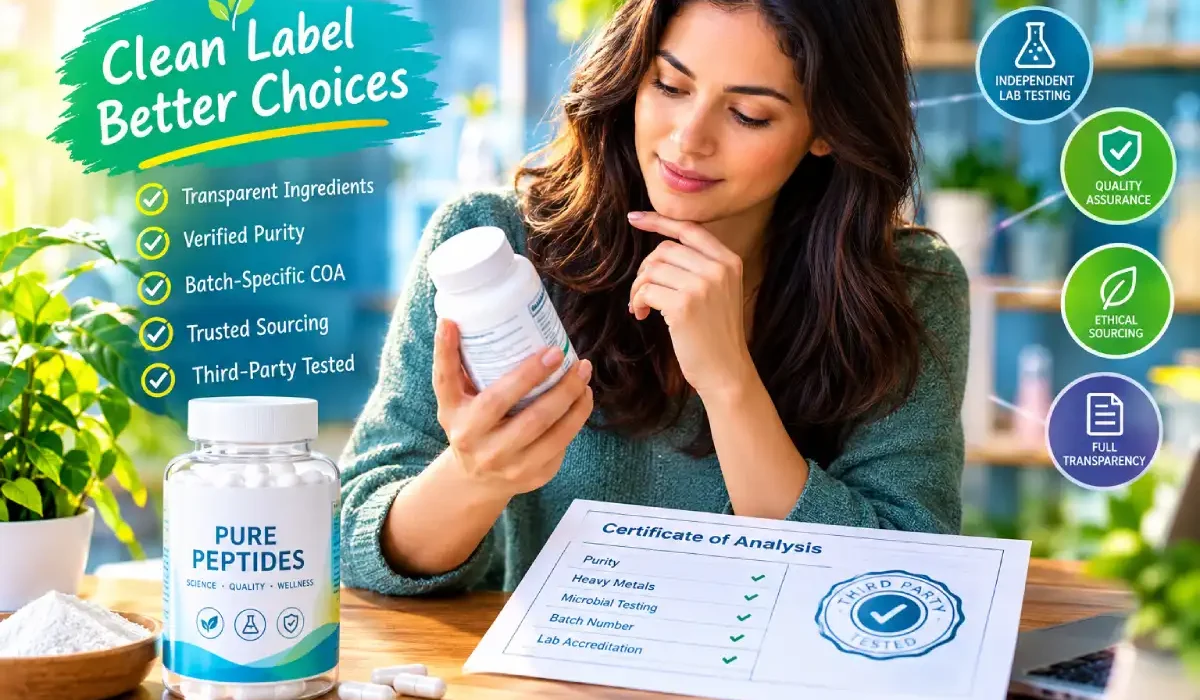
Clean-label thinking translates directly into documentation standards in the pure peptides space. A product with independently verified purity, batch-specific certificates of analysis, and transparent sourcing is the peptide equivalent of clean label. The content is known. It’s been externally verified. It can be traced to a specific production run.
That level of traceability used to feel like a premium offering. It doesn’t anymore. An increasing number of buyers have decided it’s the floor, not a feature worth paying extra for.
What Shoppers Are Actually Demanding Now
The questions have shifted. “Is this natural?” and “Is this premium?” aren’t leading anymore. What’s leading now: which lab ran the testing, and does it hold relevant accreditation? Is this certificate batch-specific or just a general quality statement? Did you test for heavy metals and microbial contamination, or just purity? These questions didn’t appear out of nowhere.
They appeared because enough people bought based on marketing language, were disappointed, and eventually figured out what they should have asked in the first place. A generation of bad purchases trained the market to be significantly less polite about it.
How Better Brands Are Responding
Suppliers who always operated with high documentation standards are discovering the market has finally caught up to them. The brands that invested in rigorous independent testing, transparent supply chains, and batch-specific documentation are the ones appearing in recommendations in communities where people actually know what they’re talking about.
The brands that relied on attractive packaging and confident language are running into buyers who have learned the right questions. A lot of those brands don’t have satisfying answers.
What This Means for Shoppers Right Now
The documentation is increasingly available. More suppliers publish certificates of analysis now than did five years ago, which is a direct result of buyer demand creating real market pressure. Use it. Don’t take a marketing claim at face value when the underlying evidence is one request away.
Three questions cut through everything: where is the certificate of analysis, which lab produced it, and is it specific to the batch being purchased right now? Those three questions, asked before buying, are more useful than any amount of label reading.
Take Away
Clean-label thinking isn’t cycling out. It’s a raised floor for what counts as acceptable documentation, and that floor keeps rising as more buyers figure out what to ask for and start asking for it.