

Last Updated: April 15, 2026
What Are Cataracts?
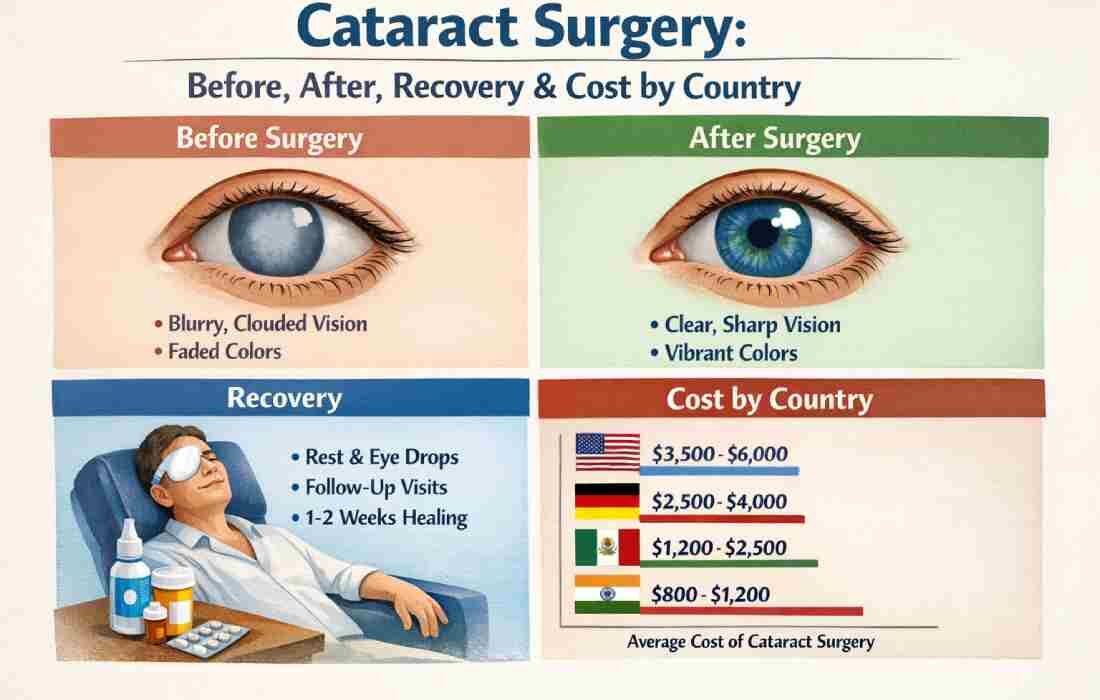
Cataracts occur when the natural lens inside your eye becomes cloudy, causing vision to become blurry, hazy, or less colorful. While cataracts are strongly associated with aging, most people will develop some degree of cataract by age 55; they can also result from eye injuries, certain medications, or medical conditions like diabetes. The only effective treatment is the surgical removal of this cloudy lens & its replacement with a clear artificial one, known as an intraocular lens (IOL).
Before Surgery: Preparing for Your Procedure
Preparation is key to a smooth experience. Before your surgery, your eye surgeon will perform a comprehensive eye exam to measure your eye’s shape and size, helping to determine the correct power of your IOL. This is also when you will discuss which type of IOL best suits your lifestyle—options include standard monofocal lenses (typically for distance vision) and premium lenses, such as multifocal toric lenses, that can correct astigmatism and reduce your dependence on glasses.
In the days leading up to the operation, your doctor may ask you to use anti-biotic eye drops to lreduce therisk of infection. You will also receive specific instructions about eating and drinking before the procedure.
During Surgery: The Procedure Itself
Cataract (Eye) surgery is typically an outpatient procedure, meaning you go home the same day. It is usually performed under local anesthetic with numbing eye drops so you remain awake but comfortable. The most common technique is phacoemulsification, where the surgeon (specialist) makes a tiny, self-sealing incision, uses ultrasound waves to break-up the cloudy lens, and then removes the fragments. The new, folded IOL is then inserted through the same small incision and unfolded into place. The entire process often takes just 10 to 20 minutes per eye.
After Surgery & Recovery Timeline
The recovery period is just as important as the surgery itself. While most people notice an improvement in their vision within a few days, full healing takes time.
- First 24 Hours: It is common to experience a scratchy, watery feeling, and your vision may be blurry or hazy. You will go home with a protective eye shield and should start using your prescribed eye drops.
- Days 2–7: Your vision should gradually become clearer each day. You will need to continue using antibiotic and anti-inflammatory drops, wear the eye shield at night, and wear sunglasses outdoors. Avoid heavy lifting, bending, or getting water in your eye.
- Weeks 2–4: Most people feel “almost normal” by this stage. You can slowly increase reading, screen time, and light exercise. Your doctor will check your vision around the 3–4-week mark and advise whether new glasses are needed.
- Up to 6 Months: The internal healing stabilizes. Any minor dryness or glare typically improves with time.
Do’s and Don’ts for a Smooth Recovery
| ✅ Do’s | ❌ Don’ts |
| Use prescribed eye drops exactly as directed to prevent infection and control inflammation. | Do not rub or press on your eye, as this can disrupt healing and increase the risk of infection. |
| Wear the protective eye shield at night for at least the first week to avoid accidental rubbing. | Do not get water, soap, or shampoo directly in your eye for 7-10 days. Avoid swimming & hot tubs for at least 2 weeks. |
| Wear sunglass when outdoors to protect your eyes from dust and bright light. | Do not lift heavy objects or engages in strenuous activities that strain the eyes for the first week. |
| Attend all follow-up appointment so your doctor can monitor the healing process. | Do not drive until your doctor confirms it is safe to do so, usually after your first follow-up visit. |
Potential Complications to Be Aware Of
Cataract surgery is 1 of the safest & most effective surgical procedures. However, as with any surgery, there are potential risks, although serious complications are rare. These can include infection (endophthalmitis), inflammation, increased intraocular pressure (IOP), retinal detachment (occurring in about 0.21% of cases within a year), and posterior capsular opacification (PCO). This common clouding can occur months or years later but is easily treated with a quick laser procedure.
Global Comparison: Cost and Wait Times (2026)
The cost and accessibility of cataract surgery vary dramatically across the world. This table provides a clear comparison for the United States, the United Kingdom, Canada, and India, using 2026 data.
| Feature | 🇺🇸 United States | 🇬🇧 United Kingdom | 🇨🇦 Canada | 🇮🇳 India |
| Public System | Medicare (65+) covers 80% of the standard surgery cost after the deductible is met. | The NHS provides free surgery if clinically necessary (e.g., affects driving). | Provincial plans (e.g., OHIP) fully cover standard surgery and a standard IOL. | Government schemes (e.g., Ayushman Bharat) and free camps provide access at low or no cost. |
| Private Cost (per eye) | $3,500 – $7,000 (standard). Premium lenses add $1,500–$3,000+. | £2,500 – £4,000 (monofocal); £3,500+ for multifocal/toric. | C$3,000 – C$5,000 (standard); C$4,000–C$6,000 for laser-assisted. | ₹15,000 – ₹25,000 (SICS manual); ₹35,000 – ₹65,000 (Phaco). |
| Typical Wait Time | Very short (days to weeks) for private/insured patients. | Highly variable: 4–6 weeks to 50+ weeks depending on region. | Long wait times: Average ~125 days in Ontario, up to 7+ months in some regions. | Very short (days) for private care. Variable for free public camps. |
| Key Takeaways | High cost but fast access, and advanced technology. | Free at point of use via NHS, but can involve long waits and standard lenses only. | Publicly funded for basic surgery, but premium upgrades and faster access require private payment. | Extremely affordable private care and government-supported options make it a global hub for medical tourism. |
Final Thoughts
Cataract surgery has reformed the lives of millions, offering a safe and reliable path to restored vision. Understanding the journey—from preoperative preparation to the day-by-day recovery—can help ease any anxiety and ensure the best possible outcome. While the cost and waiting times vary significantly by country, the procedure itself is consistently effective across the globe. If you are experiencing symptoms of cataracts, the first step is to schedule a comprehensive Cataract exam with an ophthalmologist to discuss your options.