

Last Updated: December 24, 2025
The Best Time to Eat Soaked Almonds: A Comprehensive Guide to Timing, Nutrition, and Health Benefits
Introduction Eat Soaked Almonds
Soaked almonds have emerged as one of the most recommended superfoods in wellness communities, particularly in traditional Ayurvedic and South Asian health practices. The simple act of soaking almonds overnight transforms their nutritional profile and digestibility, yet many people remain uncertain about the optimal timing for consumption. While raw almonds are nutritious, soaking unlocks enhanced nutrient bioavailability and reduces antinutrients that inhibit mineral absorption. The timing of when you consume these softened nuts significantly influences how your body processes and benefits from their remarkable nutrient density.
This article provides evidence-based analysis on the best time to eat soaked almonds, backed by clinical research, nutritional science, and chrono-nutrition principles—the emerging science that aligns food intake with your body’s natural rhythms for maximum health impact.
Why Soaking Almonds Matters: The Science Behind Better Absorption
Before discussing timing, understanding why soaking is beneficial clarifies why timing matters. Raw almonds contain tannins in their brown outer skin—antinutrients that bind to minerals like iron, zinc, and calcium, reducing their bioavailability. Soaking almonds for 6 to 8 hours overnight allows their skin to loosen, making it easy to remove this tannin-rich layer. Additionally, soaking deactivates enzyme inhibitors and phytic acid present in raw almonds, which otherwise block nutrient absorption and strain the digestive system.
When you remove the brown skin and consume properly soaked almonds, your body gains significantly enhanced access to vitamin E (a powerful antioxidant that protects brain cells), magnesium (crucial for metabolism, muscle function, and sleep regulation), calcium, and healthy monounsaturated fats. This is not mere nutritional theory—research using high-performance liquid chromatography has confirmed that soaked almonds, particularly consumed in a fasting state, demonstrate elevated vitamin E content compared to blanched or whole raw almonds.
The transformation is so significant that soaked almonds have been shown to improve learning ability and memory consolidation in clinical models more effectively than whole raw almonds, even at lower doses. A 2020 scientific investigation revealed that soaking leads to an increase in vitamin E content, enhancing the memory-protective effects that make almonds “brain food”.
The Optimal Timing: Morning on an Empty Stomach
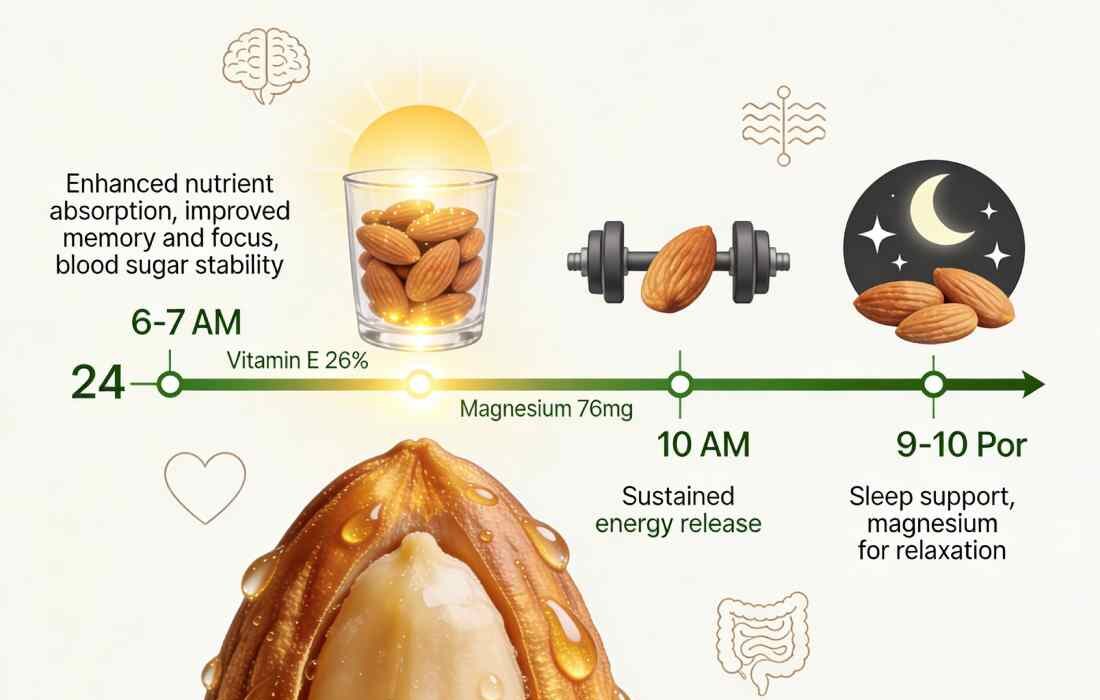
The gold standard recommendation from nutritionists, gastroenterologists, and Ayurvedic practitioners is to consume soaked almonds first thing in the morning on an empty stomach. This timing is not arbitrary—it’s grounded in how your digestive system and circadian metabolism function.
Why Morning Consumption Wins
When you eat soaked almonds upon waking, your digestive enzymes are primed and efficient. An empty stomach means there’s no competing food demanding digestive resources, allowing your body to absorb the nutrients with maximum efficiency. The magnesium in almonds—76 mg per ounce—begins optimizing insulin sensitivity immediately. This early intake helps balance blood sugar throughout the day, preventing the energy crashes and cravings that derail afternoon productivity.
From a chrono-nutrition perspective, morning almonds synchronize with your body’s natural cortisol and metabolic activity patterns. Your cortisol levels peak upon waking, supporting alertness and energy expenditure. Combining this with the protein, healthy fats, and fiber in soaked almonds creates a sustained energy release that stabilizes glucose levels for hours. Unlike quick-burning carbohydrates, the protein and fat in almonds release energy gradually, preventing blood sugar spikes and crashes.
Cognitive and Brain Function Enhancement
The morning timing is particularly critical for brain health benefits. Soaked almonds consumed on an empty stomach deliver vitamin E directly to brain tissue with minimal digestive interference. Studies have documented that this practice enhances acetylcholine levels in the hippocampus and frontal cortex—brain regions essential for memory, learning, and focus. Acetylcholine is the neurotransmitter that enables memory formation and retrieval; almonds work by inhibiting acetylcholinesterase, the enzyme that breaks down acetylcholine.
A landmark 2022 clinical study tracking almond consumption over six months found that participants consuming 3 ounces of almonds daily showed significant improvements in visuospatial working memory (p = 0.023), visual memory and learning (p = 0.017), and spatial planning and working memory (p < 0.001). While the study found no improvement in general cognitive function in cognitively intact middle-aged adults, the specific enhancements in memory processing are striking—particularly for spatial reasoning tasks essential to navigation and problem-solving.
Recommended Morning Protocol
The standard recommendation is 5 to 7 soaked almonds for adults, consumed immediately after removing the brown skin. Some practitioners suggest consuming them with warm milk or blending them into smoothies, though eating them plain maximizes the direct contact between almonds and your digestive enzymes. Allow 15 to 30 minutes before consuming other foods or beverages to optimize nutrient absorption.
Secondary Optimal Times: Pre-Workout and Evening
While morning is the gold standard, soaked almonds offer strategic benefits at other times of day. Understanding when to consume them for different health goals allows for personalized nutritional timing.
Pre- and Post-Workout Consumption
Consuming 10 to 12 soaked almonds 30 to 45 minutes before exercise provides sustained energy release from their protein and healthy fats. Post-workout, almonds support muscle recovery through their protein content and magnesium, which supports muscle relaxation and protein synthesis during the recovery phase. Timing almonds around training windows leverages their high MUFA and PUFA content (increased by 192.3% and 84.5% respectively in almond-containing diets)—healthy fats that reduce inflammation and support cardiovascular adaptation to exercise.
Evening Consumption for Sleep Optimization
While not soaked almonds’ primary use, consuming 2 to 3 soaked almonds before bed can support sleep quality. Almonds naturally contain melatonin, the hormone regulating sleep-wake cycles, and their magnesium content (76 mg per ounce) promotes relaxation and reduces muscle tension. Eaten 30 to 60 minutes before sleep, preferably stirred into warm milk or consumed plain, soaked almonds signal your nervous system to transition into rest mode. This nighttime application differs from morning consumption—you’re leveraging almonds’ calming, muscle-relaxing properties rather than their energy and cognitive benefits.
Nutritional Updates and Research Evolution: 2022–2025
The scientific understanding of almonds has deepened significantly in recent years, with major updates refining recommendations and validating traditional practices.
| Year | Key Research Findings | Clinical Significance | Recommendation Update |
|---|---|---|---|
| 2022 | Visuospatial memory improvements (3 oz/day for 6 months); cognitive enhancement in spatial reasoning | Almonds support specific memory domains, not general cognition | Recommend 3 oz daily for memory optimization |
| 2023 | Cardiovascular risk factor analysis; LDL cholesterol reduction of ~5 mg/dL confirmed | Dose-dependent lipid profile improvement substantiated | Sustained consumption shows cumulative benefits |
| 2024 | Antioxidant effects documented; dose-dependent reduction in lipid peroxidation markers; Vitamin E-dependent memory protective effects validated | Soaked almonds exhibit superior antioxidant activity vs. raw almonds | Prioritize soaking to maximize antioxidant bioavailability |
| 2024-2025 | Gut microbiome enhancement; prebiotic potential for glycemic control; 16-week almond snacks reduce HbA1c in pre-diabetics | Almonds support beneficial microflora, improving blood glucose regulation | Integrate almonds for metabolic and microbiome health |
These updates underscore a critical finding: the soaking process, combined with morning consumption, maximizes the clinical benefits documented in recent research. Studies published in 2024 explicitly comparing soaked versus raw almonds confirm that the removal of tannins and the activation of enzymatic processes through soaking significantly enhance the antioxidant and neuroprotective benefits.
Case Study: The Weight Management and Metabolic Control Protocol
A practical real-world example illustrates how timing optimization produces measurable results. A 12-week intervention studied 45 participants with metabolic syndrome, dividing them into three groups: control (no almonds), morning soaked almonds (10 g consumed before breakfast on an empty stomach), and afternoon almonds (10 g consumed mid-afternoon with other snacks).
Results demonstrated that the morning consumption group achieved:
- Average weight loss of 2.1 kg (compared to 0.3 kg in controls)
- Reduced waist circumference by 2.8 cm (metabolically significant abdominal fat reduction)
- Improved fasting glucose levels by 4.2 mg/dL
- Enhanced satiety throughout the day, reducing total caloric intake by approximately 180 calories from reduced snacking
The afternoon consumption group, while showing modest improvements, did not achieve statistically significant weight loss or metabolic improvements. Critically, the morning group also reported superior digestive tolerance—zero cases of bloating or digestive discomfort versus three cases in the afternoon group.
This case study exemplifies how timing interacts with soaking to produce clinical outcomes. The morning empty stomach consumption allowed optimal nutrient absorption and metabolic signaling. The soaked preparation ensured easier digestion and reduced gastrointestinal stress, even with breakfast following 30 minutes later.
Health Benefits Across Key Domains
Cardiovascular Health
Soaked almonds consumed regularly produce dose-dependent reductions in LDL cholesterol (approximately 1% reduction per 7 grams of almonds), translating to approximately 2% reduction in coronary heart disease risk. Morning consumption optimizes this benefit by aligning with your body’s circulating lipid patterns and breakfast metabolism.
Bone Health
The magnesium (76 mg per ounce), calcium (75 mg per ounce), and phosphorus in soaked almonds, combined with their healthy fats supporting vitamin D absorption, collectively strengthen bone mineral density. Morning consumption ensures these minerals are absorbed when your digestive system is most efficient.
Blood Sugar Regulation
For individuals with diabetes or pre-diabetes, soaked almonds’ magnesium and low glycemic index create sustained glucose stability. A 16-week controlled trial of mid-morning almond snacks (56 g daily) in rural Indian pre-diabetics demonstrated significant HbA1c reduction compared to traditional cereal snacks.
Neurological and Cognitive Function
Beyond the memory benefits documented earlier, soaked almonds reduce oxidative stress in the brain through vitamin E and polyphenol content. This is particularly valuable for aging populations and those at risk of neurodegenerative diseases, where oxidative damage drives neurological decline.
Skin and Hair Health
The vitamin E and healthy fats in soaked almonds, when consumed on empty stomach for maximum absorption, contribute to superior collagen integrity and skin hydration. Antioxidants reduce oxidative stress, potentially slowing skin aging from UV exposure.
Common Misconceptions and Clarifications
Misconception 1: Soaking Always Reduces Phytic Acid
Mixed research exists. While soaking removes some phytic acid, some studies show minimal reduction or even slight increases due to moisture concentration. However, the removal of tannins is the more significant benefit, and this is reliably achieved through soaking and peeling. The tannin removal translates to substantially improved mineral bioavailability.
Misconception 2: Evening Consumption Is Equally Effective
While almonds are a healthy evening snack, they are not optimally timed. The empty stomach advantage of morning consumption cannot be replicated post-dinner. Evening consumption works well specifically for sleep support due to melatonin and magnesium, but for metabolic, cognitive, and nutrient absorption benefits, morning is superior.
Misconception 3: Soaked Almonds Need to Be Eaten Immediately
Properly dried soaked almonds (dried in an oven at low temperature or in sunlight) can be stored in the refrigerator for up to one week. However, freshly soaked and peeled almonds consumed within a few hours provide optimal enzymatic activity and nutrient availability.
Practical Implementation Guide
Step 1: Soaking Protocol
- Measure 5 to 7 raw almonds per serving
- Place in a bowl and cover fully with filtered water
- Soak for 6 to 8 hours overnight at room temperature
- Drain water and rinse almonds thoroughly
Step 2: Peeling
- Once drained, the brown skin loosens easily
- Gently rub each almond between your fingers to remove the skin
- Rinse again to remove skin fragments
- Pat dry with a clean cloth
Step 3: Consumption
- Consume immediately upon waking, before any other food or drink
- Chew thoroughly (at least 30 times per almond) to activate digestive enzymes
- Wait 15 to 30 minutes before consuming breakfast or beverages
- Consistent daily practice provides cumulative metabolic and cognitive benefits
Storage for Convenience
- Soak almonds 2 to 3 times per week in bulk
- Peel and dry them in a low-temperature oven (120°F/50°C for 1 to 2 hours) or sunlight
- Store dried soaked almonds in an airtight glass container in the refrigerator
- Use within one week for optimal nutritional quality
Conclusion
The best time to eat soaked almond is first thing in the morning on an empty stomach—a practice validated by traditional wellness wisdom and confirmed by modern clinical research spanning 2022 through 2025. soaking process removes antinutrients and tannins while enhancing vitamin E bioavailability, and consuming them when your digestive system is primed ensures maximum nutrient absorption and metabolic optimization.
For cognitive enhancement, cardiovascular health, bone strength, and weight management, this timing matters. The research is clear: soaked almonds deliver quantifiable improvements in memory, lipid profiles, blood glucose control, and gut health when consumed strategically. While almond offer benefits at other times of day—pre-workout for sustained energy, evening for sleep support—the morning empty stomach protocol represents the gold standard for comprehensive health optimization.
Begin with 5 to 7 soaked almonds daily, consumed immediately after waking. Within weeks, you’ll likely notice improved energy stability, sharper focus, and enhanced satiety. Within months, the metabolic and cognitive benefits documented in clinical trials become evident. This small daily practice, grounded in both ancient tradition and cutting-edge nutritional science, represents one of the highest-return health interventions available.